




Tech Fan Theory
Preamble
Tech Fan Theory aims to establish data in Mandarin and thereby promote tech fan in the Sinophone world. *THIS IS A TRANSLATED ENGLISH VERSION OF THE ORIGINAL ESSAY*
This article is based on references from Home Of Fans, Facebook communities, and Wikipedia, and is summarized from personal experience. This article will briefly describe the historical context, introduce fundamental techniques and common tricks, and analyze core characteristics.
This article is based on references from Home Of Fans, Facebook communities, and Wikipedia, and is summarized from personal experience. This article will briefly describe the historical context, introduce fundamental techniques and common tricks, and analyze core characteristics.
Tech fan, which is more formally known as “Acrobatic fire fans”, belongs to the contemporary new circus arts. The physical shape of the object resembles a semi-circular folding fan, the primary performance form is acrobatics, and it was originally designed as a prop for fire dancing. The acrobatic fire fans mentioned in this article specifically refer to the mainstream techy Russian-style large ring fans, whether they are used with fire or not. For the sake of simplicity and in accordance with the custom in fans community, they are colloquially referred to as “tech fan” or “fire fans”.
Taiwanese Tech Fan Performer YiHsuan Chen
2023.09.11 First edition
2024.04.01 Revision-1
2024.05.20 Revision-2
2024.06.04 Revision-3
2025.02.14 Revision-4
2025.10.10 Revision-5
History
Embryonic
The origins of fire arts can be traced back thousands of years. Civilizations around the world have incorporated fire into their religious and cultural ceremonies, dances, and festivals, such as the Samoan fire knife dance and the Tahitian fire dance in Polynesia. From the late 19th century to the 20th century, modern fire arts gradually came into the public’s view. Fire-breathing, fire-eating, and other fire juggling were commonly seen in circuses and musicals. By the end of the 20th century, large events like the Burning Man Festival led to a flourishing development of the global fire performance. With the rise of the Cirque Nouveau, many new object manipulation props appeared in contemporary fire arts performances. Fire fans might have also emerged during this period.
At the end of 2006, American artist Grimm Zimmer uploaded what is currently known to be the earliest video with elements of contemporary acrobatic fire fans on YouTube. In early 2009, Russian artist Marina Vinokurova released the first video of Russian-style fire fans. By the end of 2009, Russian artist Roman Anufriev (Rem) released his first personal tech fan video (he later became a renowned grandmaster of fans), marking the beginning of distinct American and Russian designs and styles.
War of the rings
The American-style fan structure uses smaller rings, and its design is generally more ornate. Its moves and style mainly draw inspiration from double short staffs and hula hoops. In contrast, the Russian-style fan structure uses larger rings, and its design is generally more streamlined. Its moves and style mainly draw inspiration from Poi. Over time, these fundamental differences became increasingly evident. In March 2010, the Fan Convention was held for the first time in Moscow, resulting in the first fire fan montage. In May 2010, American artists Grimm Zimmer and Corey White, among others, released the montage “Evolution of Fans”, challenging the Russian style. In response, in June 2010, Russian artists Rem and Anika, among others, released the montage “U.S.S.R.” (Union’s of Soviet Spinners Response). Later the Russian montage continues to publish similar collaborations almost every year. Unfortunately, there hasn’t been a second American-style montage to date. The Russian-style large ring fans gradually became mainstream.
Growth
In the 2010s, fire fans rapidly developed, with many technically skilled and influential artists emerging. This includes Russian artists like Mariya Prokazina and Tatyana Lundyak, and American artists like Doodle and Becca Becker. An increasingly rich array of online teaching resources was born during this period. Russian tutorials include Rem’s “Home of Fans Fire Fan Tutorials” and Mariya’s “Fire Fans School”, while American tutorials were introduced by artists like Doodle, Robin McPlurry, and Jessy Spin. This era saw a blossoming of diverse styles and vigorous discussions. Fire fans began to appear widely at major art festivals and fire dance competitions and spread to Western Europe and East Asia, including Taiwan.
Fans in Taiwan
In Taiwan, the early traditional folk funeral rite “Nong Nao” was a juggling and stunt performance rich in folklore, which included acts like jumping through fire hoops and fire-eating. This is recognized as the earliest form of fire arts in Taiwan, while Taiwan’s contemporary fire performances mainly originated from the Scouts and orientation camping bonfire night. Only after the occurrence of the “Taiwan Fire Soul” did they begin to coalesce and evolve. In the early days, long staff and meteor dominated, with fire fans being quite rare, often used merely as decoration. In 2016, Lila Wang from NTUFD presented the first performance in Taiwan with elements of contemporary acrobatic fire fans at the Taiwan Fire Soul VIII. In 2017, YiHsuan Chen from the same club showcased Taiwan’s first Russian-style fire fans performance at the Taiwan Fire Soul IX. At the same time, MinHua Tsai from the CCUFD won the newcomer group championship using fire fans, marking the beginning of a new era for fire fans in Taiwan. In 2019, YiHsuan Chen gathered top fire fans artists in Taiwan to formed the troup Pineapple Tetrapod. Their entry at the Taiwan Fire Soul X was Taiwan’s first fire fans group performance.
Present
In the early 2020s, the development of fire fans (along with the entire performance community) faced unprecedented challenges and decline. The outbreak of Covid-19 at the end of 2019 wreaked havoc across the globe for over two years. Subsequently, in early 2022, the full-scale war between Russia and Ukraine began and has continued without cessation to this day. During this period, art festivals and competitions were either canceled or moved online, affecting countless artists and performance stages. The situation only began to improve by mid-2023, and in Taiwan, it even rebounded to an unprecedented peak. The significant increase in fire fan performers further gave rise to numerous new events. improved.
Learn Fire Fans
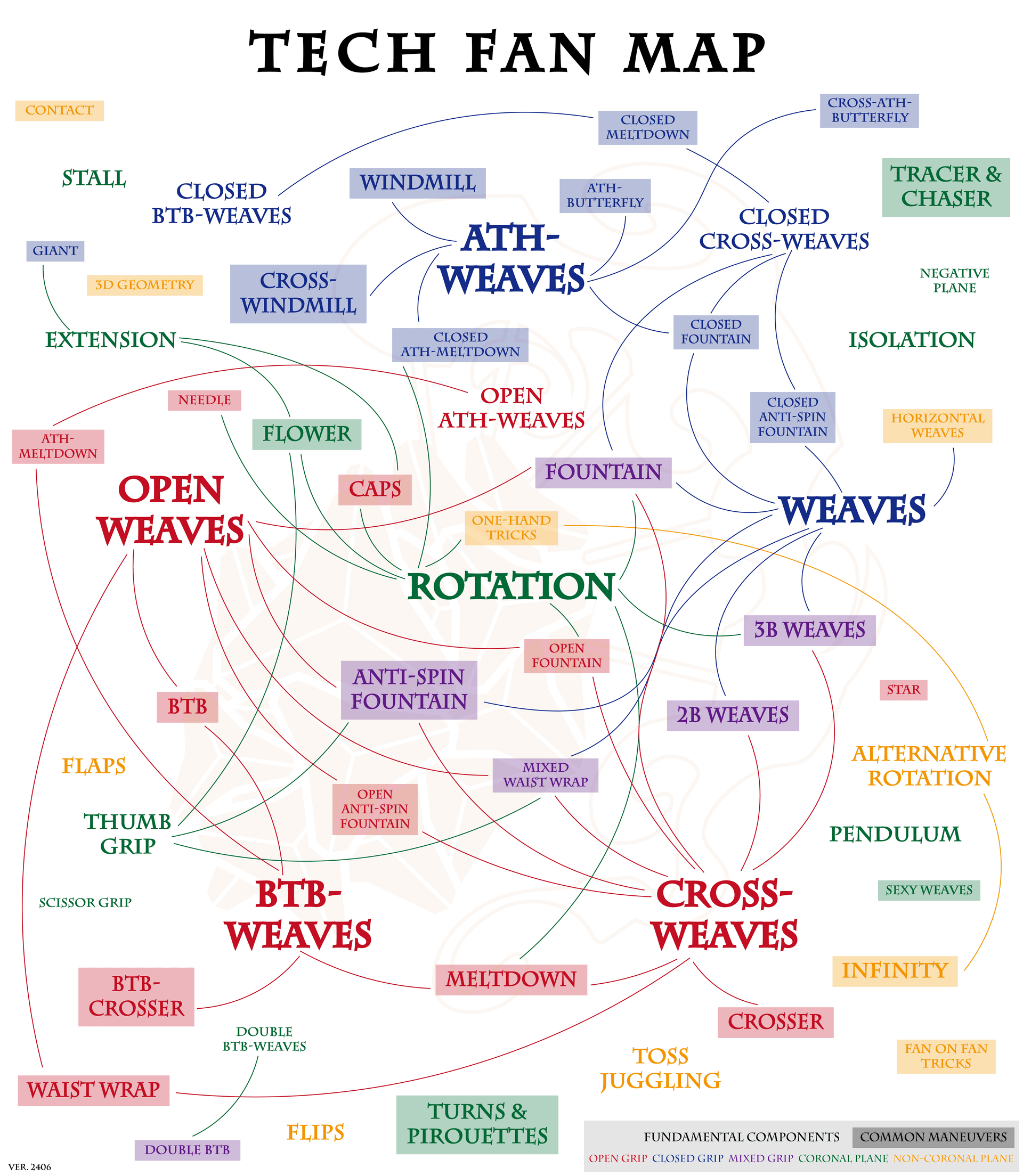
The “Tech Fan Map” aims to establish a global perspective, introducing common tricks of fire fans and their fundamental techniques, and providing a reference for learning.
In the diagram, based on whether there is a mesh background, it can be divided into Fundamental Components (without mesh) and Common Maneuvers (with mesh). Based on different colors, they can be categorized as Open Grip (red), Closed Grip (blue), Mixed Grip (purple), Coronal Plane (green), and Non-Coronal Plane (orange). The importance and frequency are roughly indicated by the font size.
Fundamental components are single-handed movements. In common maneuvers, apart from a few special tricks, most are formed by both hands each performing a fundamental component in coordination.
Fire fans performances are choreographed sequences of these maneuvers set to music. Among the fundamental components, there are six essential basic techniques: Weaves, Open Weaves, Cross-Weaves, BTB-Weaves (Behind The Back), ATH-Weaves (Around The Head), and Rotation. These techniques are crucial, forming the elements of more than half of the fire fans maneuvers and must be mastered. The three intermediate techniques Open ATH-Weaves, Closed Cross-Weaves, and Closed BTB-Weaves are relatively challenging and not easily used but are indispensable in some common maneuvers. Advanced techniques break the mold of fixed-plane and fixed-direction rotation, establishing the distinctiveness between fire fans and other fire dance props.
What’s considered difficult or easy, common or rare, and good or bad effects are all inherently subjective, varying from person to person with no fixed standard and are provided here for reference only. The order in which individual techniques and tricks are learned can be adjusted based on personal proficiency and preference. However, in general, one should progress step by step: first establishing stability in the coronal plane rotation, then adding axial rotation and non-coronal plane rotation, and finally breaking the established framework. Additionally, the provided common maneuvers are merely a starting point for reference. There’s no limit to the combination maneuvers, no ceiling to creativity and innovation, and no end to improvement.
Characteristic
Shape
The object itself is a plane, while the flaming part is an arc. In terms of rotation methods, from an intrinsic coordinate system perspective, it can either perform Plane Rotation (Z-axis rotation) or Axis Rotation (X-axis rotation and Y-axis rotation).
From the user’s coordinate system perspective, movements can be categorized into Coronal Plane Rotation (rotation around the user’s Y-axis) and Non-Coronal Plane Motion (free movements). The Non-Coronal Plane Motion encompasses a variety of movements, including Sagittal Plane Rotation (rotation around the user’s X-axis) and Horizontal Plane Rotation (rotation around the user’s Z-axis), among others not specified.
In terms of visual effects, when two fire fans are on the same plane, there are four primary relational patterns: O-Relation, S-Relation, W-Relation (appearing as I-Relation when viewed perpendicularly), and X-Relation.And because relationships within a maneuver often undergo frequent changes, they are typically represented by the relationship at the beginning.


Grip
The way fire fans are held, due to the planar nature of the prop, can be categorized into Open Grip (O.G.) and Closed Grip (C.G.). When the performer’s hand enters the ring from the side of their body to the opposite side, it is considered an Open Grip. When the hand enters the ring from the opposite side towards the side of their body, it is a Closed Grip. Any other grips that don’t fall into these two categories are rare and considered special grips. Switching between Open and Closed Grips can be achieved using techniques like Alternative Rotation, Flaps, Scissor Grip, or Tosses. Changing the part of the fan you hold (e.g., holding the inner or outer ring) or using the Thumb Grip doesn’t alter the grip type. Additionally, when a maneuver involves one hand using Open Grip and the other using Closed Grip, it’s referred to as Mixed Grip (M.G.).

Direction
For one single fan’s rotation, it can be categorized as Thumb Lead (T.L.) or Pinky Lead (P.L.). Due to the special characteristics of the two grip methods for fire fans, Open and Closed Grip, it’s not appropriate to use the traditional terms “Forward” or “Backward”. From an objective viewpoint, rotations are described as Clockwise or Counterclockwise from the user’s point of view. In maneuvers involving two fire fans, based on their rotation direction, they can be categorized as Same Direction (S.D.) or Opposite Direction (O.D.).

Timing
In maneuvers involving two fire fans, based on the angle of their rotations, they can be categorized as Together Time (T.T.) or Split Time (S.T.). When combining time phasing with rotation direction in maneuvers, it forms the commonly seen four timing and directions: Synchronous, denoted as Together Time Same Direction (T.S.); Left-Right Mirrored, denoted as Together Time Opposite Direction (T.O.); Symmetrical, denoted as Split Time Same Direction (S.S.); and Up-Down Mirrored, denoted as Split Time Opposite Direction (S.O.).

Trajectory
The simultaneous rotation of the arm and the fire fan on a plane forms trajectories, which can be divided into the In-spin (Spin) and Anti-spin. When the direction of the arm’s rotation is the same as the fire fan’s rotation, it’s called In-spin. When the direction of the arm’s rotation is different from the fire fan’s rotation, it’s called Anti-spin.

Beat
In a sequence of movements, from the start (choose any starting point you like for recyclable movements) to the end (the starting point for recyclable movements), the number of times the fire fan rotates (or pointing vertically downward for recyclable movements) is referred to as the beat of the movements (this definition does not apply to movements that do not involve rotations on a coronal plane and some toss juggling). In usage, beat are typically abbreviated as “b”, such as 0b for zero beat (the fire fan does not complete a full rotation), 1b for one beat (including an Extension), and 2b for two beats.
While performing Flower, petal are commonly used instead of beat, which provides a more intuitive understanding. In usage, petal are typically abbreviated as “p”, such as 1p Flower, and 3p Flower. The conversion rules of “p” and “b” depend on the trajectory: in In-spin, b = p + 1, while in Anti-spin, b = p - 1. For instance, a 2p In-spin Flower completes in three beats, whereas a 4p Anti-spin Flower also completes in three beats.
In common maneuvers, it’s typical for both hands to have the same number of beats. If the beats are not consistent, it’s referred to as a Hybrid Maneuver, and the number of beats is defined by the hand with the greater number of beats in that combination.

Choosing Fire Fans
General rules
Through live performances or online video resources, choose fire fans that are the same model as those used by your favorite artists. Then, based on your own physical condition and ability, make minor adjustments to the size, weight, and other specifications.
Ring size
The rings of the fire fans can be divided into the Large ring (Russian grip) and Small ring(s) (American grip), differentiated by whether the entire palm can easily fit into the ring. The concept of the Russian grip is a single ring, with an inner diameter larger than the width of the palm. Without meeting this prerequisite, most Russian-style techniques cannot be executed. The appropriate inner diameter (I.D.) of the ring is the width of the palm plus 1.5 cm (19/32 inches). Generally speaking, the classic inner diameter is 8.5 cm (3 and 11/32 inches), and the wire diameter (W.D.) is usually around 1.2 cm (15/32 inches). The American grip is sized to fit one or two fingers, with one or multiple rings. Typically, only one finger uses one main ring for manipulation. Small rings offer higher stability but sacrifice some rotational freedom. This article discusses the acrobatics of large ring fans, so the American grip is not considered.
Ring material
The primary consideration for the ring section of the fire fans is a smooth, flat surface with low friction. Common materials include metal, leather, and plastic. Generally speaking, polished stainless steel or copper-plated stainless steel is the best choice. Heat-treated 3D printing also performs well. Metal covered with leather or plastic tubing is feasible, but the quality tends to be inconsistent and it wears out more easily. Using tape or paint is strongly discouraged.
Size and Weight
The size of the fire fan is represented by the distance from the ring to the wick. The suitable size is the length of the user’s palm to the elbow plus or minus 3 cm (1 and 3/16 inches). Generally speaking, the classic sizes are 30 cm (11 and 13/16 inches) and 35 cm (13 and 25/32 inches). Within a reasonable range, the larger the fire fan, the better the visual effect; the smaller the fire fan, the better its operability. The weight of the fire fan is represented by the weight of the frame (excluding the wicks). The appropriate weight ranges from 250 g (0.55 lbs) to 350 g (0.77 lbs). Within a reasonable range, the heavier the fire fan, the more stable it is on a plane; the lighter the fire fan, the more flexible its operation.
Center of gravity
Ideally, the center of gravity of the fire fan should be located at the exact midpoint between the ring and the wick on the central frame. In practice, the suitable center of gravity should be located about 1/3 of the way from the grip ring on the central frame before soaking in fuel (B.C.G.), and about 1/3 of the way from the flame head on the central frame after soaking (A.C.G.). The closer the center of gravity is to the wicks, the easier it is to rotate on the plane. The closer the center of gravity is to the ring, the easier it is to rotate around its axis.
Material and shape
The primary consideration for the material of the fan’s frame is its hardness and heat resistance, and it is generally made of stainless steel with a diameter between 2 mm (5/64 inches) and 3 mm (1/8 inches). The shape of the fire fans prioritizes safety, followed by strength and aesthetics. One should avoid unnecessary decorative frames and small rings. Classic designs include the spider-shape, fan-shape, and lotus-shape. The stopper is a semi-circle ring located below the grip ring, aimed at enhancing control when holding the fans. The primary consideration for the material of the stopper is its friction. A metal covered in rubber is the best choice, but using the same material as the grip ring is also acceptable. For safety, the gap between the stopper and the ring should be smaller than the size of a finger, and shapes other than semi-circles are strongly discouraged.
Wick shape and material
The wick refers to the burning part of the fire fans. It typically has a cylindrical shape (Roll), with a few being in a knot shape (Twister Knot). The common size is approximately 2.5 cm (1 inch) in diameter (D) and 5 cm (2 inches) in length (L). The larger the surface area of the wick, the bigger the maximum flame will be. The larger the volume of the wick, the longer the burn time. The primary consideration for the material of the wick is its high ignition point. Kevlar, widely used in fire dancing tools, is the popular choice. Another option is ceramics. This material is relatively cheaper, but when new wicks made from it are burned, some ceramic powder may fall off and potentially cause skin allergies.

Buying Fire Fans
Uncle Druulians (Russia)
[Discontinued] [Warning] Reported cases of abandoned orders
Once a top recommended choice, it remains an excellent option on the secondhand market. The Uncle Fan is widely regarded as a benchmark in fire fans, earning consistently high user reviews. Its design is simple yet meticulously crafted, featuring a smooth grip ring, stable balance, and durable construction. Previously, it was priced around $200 USD (≈6,000 TWD), no current price information available.Mr.Zhao_Made (Taiwan)
Highly recommended, this is our official partner manufacturer and a locally made Taiwanese fire fan, currently considered a top choice on the market. Compared with the Uncle Fan, its main differences are the use of a solid stainless steel grip ring instead of a hollow copper ring, making it more durable but slightly heavier, and the auxiliary rings are more prone to loosening by design. Customization is available, with a price of approximately $200 USD (≈6,000 TWD).
Highly recommended, this is our official partner manufacturer and a locally made Taiwanese fire fan, currently considered a top choice on the market. Compared with the Uncle Fan, its main differences are the use of a solid stainless steel grip ring instead of a hollow copper ring, making it more durable but slightly heavier, and the auxiliary rings are more prone to loosening by design. Customization is available, with a price of approximately $200 USD (≈6,000 TWD).
Home of Poi (New Zealand / USA)
Currently the most affordable fire fan on the market, it is recommended to choose the version with self-sewn wicks. Its obvious drawbacks include a metal core wrapped in painted plastic for the grip, resulting in a poor feel, and a structure that is easily bent or broken. Excessive decorative small rings and auxiliary rings with large gaps significantly affect handling and pose safety concerns. No customization is available, and the price is approximately $60 USD (≈1,800 TWD).
Currently the most affordable fire fan on the market, it is recommended to choose the version with self-sewn wicks. Its obvious drawbacks include a metal core wrapped in painted plastic for the grip, resulting in a poor feel, and a structure that is easily bent or broken. Excessive decorative small rings and auxiliary rings with large gaps significantly affect handling and pose safety concerns. No customization is available, and the price is approximately $60 USD (≈1,800 TWD).
E-Poi (Russia)
[Warning] Do not accept international orders
Sells the well-known Misha Fans, offering a high cost-performance ratio. The main drawbacks are the metal core wrapped in leather grip, which feels uncomfortable, and the wicks are limited to ceramic fiber only. No customization is available, with a price of approximately $60 USD (≈1,800 TWD).SvetoBobr (Russia)
[Warning] Reported cases of quality control issues
Sells modular fire fans based on his well-known travel fan, featuring a heat-treated 3D-printed grip and four detachable small fire sticks. This is a non-traditional, innovative option that has received mixed reviews. Customization is available, with a price of approximately $120 USD (≈3,600 TWD).Antispins (Taiwan)
Another local Taiwanese brand, made domestically. Customization is likely available, and the previous price was approximately $130 USD (≈4,000 TWD), no current price information.
Another local Taiwanese brand, made domestically. Customization is likely available, and the previous price was approximately $130 USD (≈4,000 TWD), no current price information.
D.E.F.Works (USA)
No user experience reviews available. Visually appealing colors, but it is recommended to choose the minimalist design without colored paint. Customization is not available, with a price range of approximately $130 to $200 USD (3,900 to 6,000 TWD).
No user experience reviews available. Visually appealing colors, but it is recommended to choose the minimalist design without colored paint. Customization is not available, with a price range of approximately $130 to $200 USD (3,900 to 6,000 TWD).
Pyroplasticien (France)
No user experience reviews available. The design is extravagant, with exposed flame head screws to be aware of. It is recommended to choose the version without fire wick. Customization is not available, with a price range of approximately $100 to $250 USD (3,000 to 7,500 TWD).
No user experience reviews available. The design is extravagant, with exposed flame head screws to be aware of. It is recommended to choose the version without fire wick. Customization is not available, with a price range of approximately $100 to $250 USD (3,000 to 7,500 TWD).
Buying Day Fans and Light Fans
NeoFlowArt (Russia)
Top recommended, from a leading Russian light dancing props manufacturer, the best LED light fan on the market, with excellent appearance and craftsmanship, outstanding lighting effects, and durability. Diverse selection, not customizable, priced between approximately $500 to $1350 (15,000-40,500 TWD).
Top recommended, from a leading Russian light dancing props manufacturer, the best LED light fan on the market, with excellent appearance and craftsmanship, outstanding lighting effects, and durability. Diverse selection, not customizable, priced between approximately $500 to $1350 (15,000-40,500 TWD).
SvetoBobr (Russia)
[Warning] Reported cases of quality control issues
Highly recommended, selling travel fans, LED light fans, and wooden fans. Travel fans are the top choice for practicing fans on the market, being visually appealing, lightweight, foldable, and portable, as well as sturdy and durable. Diverse selection, customizable, priced between approximately $70-$300 (≈2,100-9,000 TWD).Easy Pixel (Ukraine)
The original name is Z-Pixel, selling LED light fans with excellent lighting effects and simple programming. Drawbacks include the uncomfortable feel of the plate-like grip ring, slightly heavy weight, and slight deformation over prolonged use. Single option, not customizable, priced at approximately $820 (24600 TWD).
The original name is Z-Pixel, selling LED light fans with excellent lighting effects and simple programming. Drawbacks include the uncomfortable feel of the plate-like grip ring, slightly heavy weight, and slight deformation over prolonged use. Single option, not customizable, priced at approximately $820 (24600 TWD).
Mr.Zhao_Made (Taiwan)
Highly recommended, this brand sells practice fans that are locally made in Taiwan, offering excellent feel, durability, and high cost-performance. Customization is available, with prices ranging from $70–110 USD (≈2,100-3,300 TWD).
Highly recommended, this brand sells practice fans that are locally made in Taiwan, offering excellent feel, durability, and high cost-performance. Customization is available, with prices ranging from $70–110 USD (≈2,100-3,300 TWD).
Tamierne (Ukraine)
[Discontinued] [Warning] Reported cases of abandoned orders
Selling painted glass fans, wooden fans, and plastic fans, all featuring excellent appearance and craftsmanship. The painted glass fan is the top choice for daylight performance. Diverse selection, customizable, priced at approximately $120 (3,600 TWD).Beast (Taiwan)
No personal experience or review on its use. Selling wooden fans, made in Taiwan, handcrafted. The designs are exquisite. Fully customizable, price information not available.
No personal experience or review on its use. Selling wooden fans, made in Taiwan, handcrafted. The designs are exquisite. Fully customizable, price information not available.
FanaticzShop (USA)
No personal experience or review on its use. Selling wooden fans and plastic fans. Diverse selection, customizable, priced at approximately $135 to $220 (4050-6600 TWD).
No personal experience or review on its use. Selling wooden fans and plastic fans. Diverse selection, customizable, priced at approximately $135 to $220 (4050-6600 TWD).
Appendix 1: References